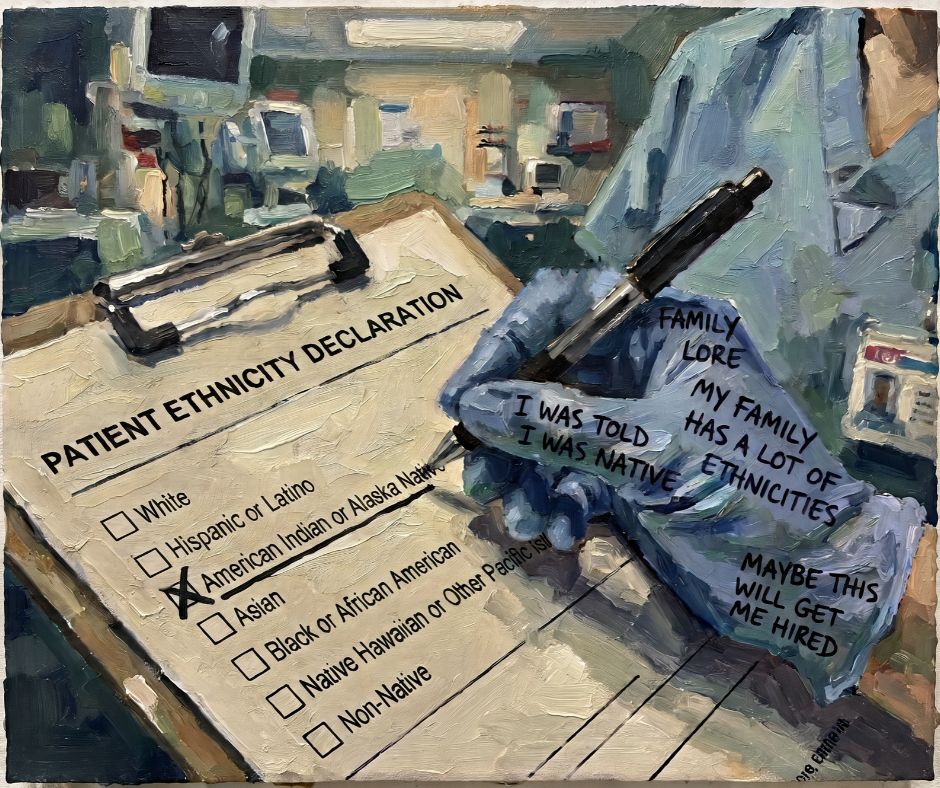
Pretendians in Nursing Schools Must Face Real Consequences
Pretendians in nursing schools are taking faculty seats, grants, and authority meant for real Native nurses, and universities must start making false claims of Native identity cost something!
Five Enrolled Native Nurse Scholars Just Named the Problem
In the November 2026 issue of Nursing Outlook, Margaret P. Moss, Cynthia Greywolf, Rydell Todicheeney, Jeneile Luebke, and Misty Wilkie called self-indigenization in academic nursing what it is, fraud and harm.
The authors include citizens of the Three Affiliated Tribes, the Turtle Mountain Band of Chippewa Indians, the Cherokee Nation, and the Bad River Band of Lake Superior Chippewa, along with a Diné scholar grounded in K′é. They write that Pretendians “have neither membership in a federally recognized tribe nor generational identification and acceptance by a community.” They also warn that a Pretendian’s claimed tribe often shifts over the years, Cherokee one season and Ojibwe or Dakota the next.
Their sharpest charge is that Pretendianism continues cultural genocide. Dr. Moss writes that she was adopted out to a White family under assimilation policy and found her mother again only after returning to her reservation in her early 20s. That is the history Pretendians borrow for credibility without ever paying its price. When a fake Indian stands at the lecture podium, nursing students learn about Indian Country from someone who never lived it.
________
Join Our Membership - Free!
________Fake Indian Art Carries Federal Penalties, So Fake Indian Faculty Should Face Consequences Too
Under the Indian Arts and Crafts Act of 1990, a person who knowingly sells a good in a manner that falsely suggests it is Indian produced can be fined up to $250,000 or imprisoned up to five years for a first violation. Congress protected the authenticity of a turquoise bracelet. Universities should protect the authenticity of a nursing curriculum, a research grant, and a faculty line with the same seriousness. Native nurses are scarce. Only 0.5 percent of registered nurses identified as Native American or Alaska Native in the 2024 National Nursing Workforce Survey, as reported by the American Association of Colleges of Nursing. Every seat taken by a pretender is a mentor and role model denied to a Native student who could have served her own people.
Indian Country has seen this before. In 1986, Elizabeth Warren wrote “American Indian” as her race on a State Bar of Texas registration card, and she was later listed as a minority and as Native American at the University of Pennsylvania and Harvard Law School, as NPR reported on her Native American claims. After she released a DNA test in October 2018, Cherokee Nation Secretary of State Chuck Hoskin Jr. said the test “makes a mockery out of DNA tests and its legitimate uses,” according to Asma Khalid’s NPR report on Warren’s apology to the Cherokee Nation in 2019. For decades a powerful woman called herself Native with no Tribal nation behind her, and too many institutions still treat that as harmless.
NASP sees the same pattern in women’s sports, where male athletes competing in women’s divisions take medals, roster spots, and scholarships from girls who earned them. An identity claimed from outside a group takes opportunity from the people inside it. In academic nursing, those people are Native women and Native nurses, and the harm reaches every community that depends on them!
NASP Stands With Native Nurses Who Tell the Truth
The authors call for a collective voice and sustained community pressure, through letters, petitions, and media coverage, on institutions that refuse to act. We agree. Nursing schools should take documented complaints seriously, consult Tribal nations, and stop rewarding a self-identification checkbox with jobs and funding. Tribal nations decide who their citizens are. That is sovereignty, and it belongs in every university hiring office. Native Americans for Sovereignty and Preservation stands with Dr. Moss, Dr. Greywolf, Dr. Todicheeney, Dr. Luebke, and Dr. Wilkie.
Share this article with a nursing dean, a Tribal health leader, or a Native nursing student, and help protect real Indigenous knowledge for the next generation.


